Albert Einstein / Misfit thinker
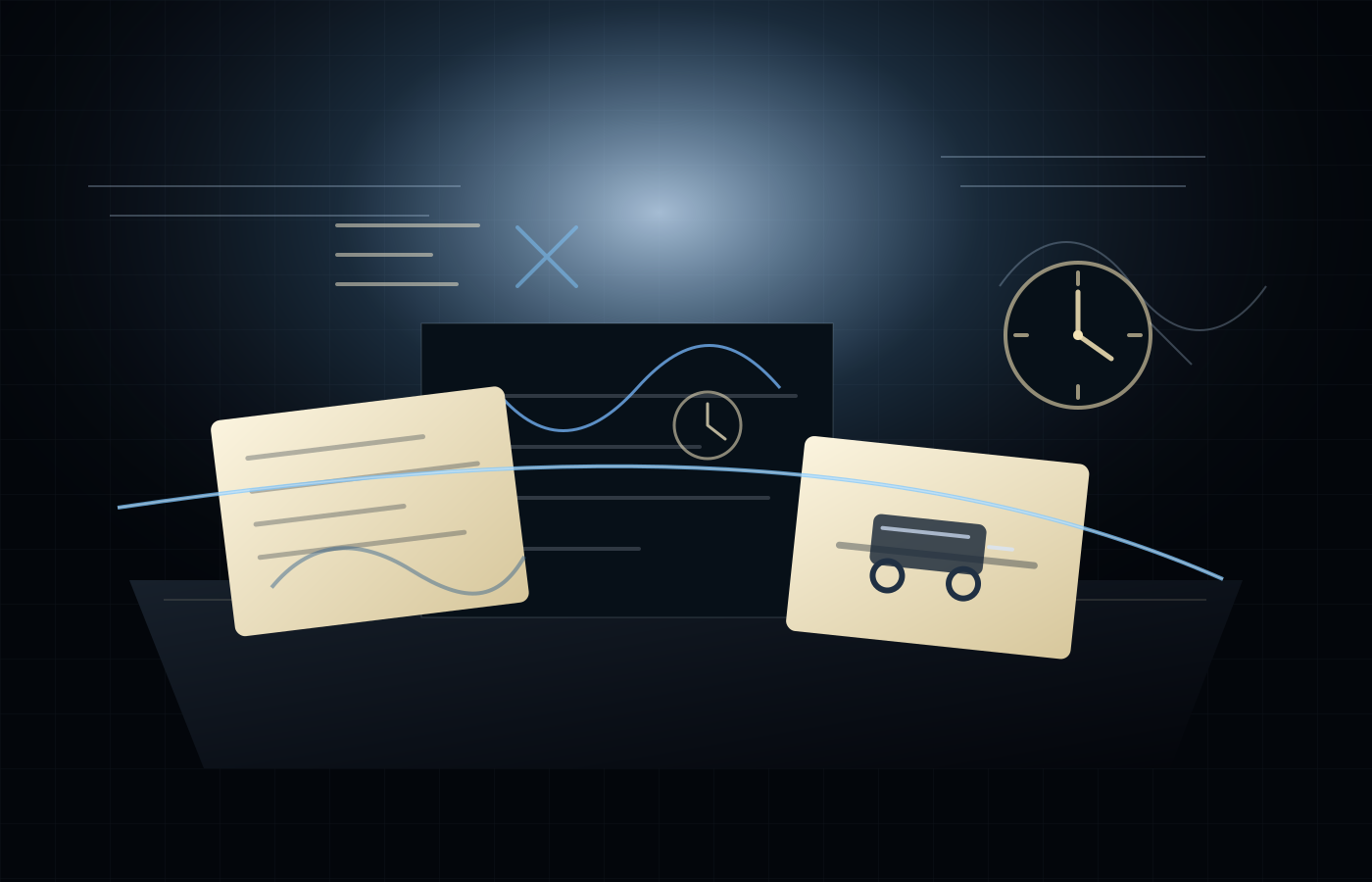
Patent Office Thought Laboratory
A quiet, luminous room for the years when an outsider examiner turned spare hours, stubborn curiosity, and private thought experiments into a new physics.
Childlike curiosity
Wonder treated as a serious instrument.
Patent office solitude
A day job that protected private physics.
Self-directed learning
A curriculum built from questions, not permission.
Interactive Biography
Not genius worship. A working model of independent thought.
Einstein is not interesting only because he was smart. He is interesting because he protected his own questions when school, work, professors, and even ordinary social life kept pushing him somewhere else.
Interactive lab
Test the idea from inside the room.
Select a thought experiment, then inspect the desk artifacts that turn biography into method: curriculum, patent files, and notebook.
Thought experiment 01
Ride beside a beam of light
What would the world look like if you could keep pace with light itself?
Thought experiment 02
Two clocks, two observers, one event
If two flashes strike a moving train, do the passenger and platform agree on what happened first?
Thought experiment 03
Change the frame, change the answer
If two observers watch the same event from different frames, which measurements change and which facts still agree?
Light frame
Einstein kept the kind of question most adults learn to dismiss. What would I see if I could ride next to a beam of light? It sounds almost childish, but this is exactly the point: he let wonder become a serious method.
Curiosity becomes powerful when it is allowed to stay with a simple question longer than convention finds polite.
Train frame
The train and clock frame keeps relativity legible without drowning the biography in equations. Einstein's originality was not only mathematical. It was the nerve to ask what an observer can honestly claim from inside a moving frame.
The breakthrough is not a decorative equation. It is a disciplined change in viewpoint.
Frame frame
Einstein's misfit temperament hurt him in institutions, but it also protected his independence. He distrusted herd thinking, built his own curriculum, and treated solitude as a laboratory. The observer frame becomes a metaphor for the whole life.
Relativity starts by separating the observer's measurement from the thing that remains true across frames.
Desk artifacts
Make your own curriculum
Learning was not a school schedule for Einstein. It was something you build for yourself: read, try, get stuck, return later, and let the hard question keep working in the background.
School ending should never mean learning ending.
Assume the mechanism is wrong
Patent work trained him to inspect claims, mechanisms, timing, and hidden assumptions. The lab borrows that habit: take a familiar idea, doubt it carefully, and work backward.
Assume the mechanism may be wrong. Then work backward until the weak assumption shows itself.
Background processing
One teaching story captures his mind perfectly: he gets stuck, moves to another topic, then suddenly returns with the answer. The problem kept running in the background.
Real learning is not notebook filling. It is honest engagement with the problem.
Miracle year atlas
The patent-office years were not quiet because nothing happened.
They were quiet because the work was still invisible. This section opens the desk drawer and follows the ideas that made the solitude matter: light, atoms, clocks, mass, gravity, fame, and consequence.
Bern, 1905
Four papers turn spare hours into a new map of reality.
The miracle year is rendered as a desk instrument, not a trophy case: paper edges, timing marks, light paths, and particles leaving evidence.
Paper 01
Photoelectric
Light packets
Paper 02
Brownian
Atoms inferred
Paper 03
Relativity
Frames tested
Paper 04
Mass-energy
Matter stores force
1905 / Light as packets
Photoelectric effect
Einstein asked a very simple but dangerous question: what if light does not only behave like a smooth wave, but also arrives in packets of energy? That idea helped explain why light can knock electrons out of metal.
This is the work that won him the 1921 Nobel Prize. Not relativity. Light itself was already strange enough.
Light becomes countable
1905 / Invisible motion
Brownian motion
Tiny particles suspended in liquid jitter in a way that looks almost random. Einstein treated that little motion as evidence for something huge: atoms were not just a useful theory, they were leaving visible fingerprints.
This is one of the best parts of 1905: he was not repeating one trick. He was opening different locked doors at the same time.
Matter leaves traces
1905 / Moving observers
Special relativity
The train, clock, and light-beam problems ask what two observers can honestly agree on. The shocking answer is that time and distance are not fixed furniture in the universe. They depend on motion.
The important move is not memorizing an equation. It is learning to ask: from which frame am I seeing this?
Time loses its throne
1905 / Energy and mass
Mass-energy equivalence
The famous equation is easy to print on a poster and hard to actually feel. It says mass is not dead weight. It is a form of concentrated energy.
That idea later gained a terrifying political shadow, even though Einstein himself was not a bomb-builder.
Matter stores force
1915 / Gravity remade
General relativity
Einstein pushed beyond trains and clocks and rebuilt gravity. Massive bodies do not simply pull through empty space. They bend the shape of spacetime, and objects move inside that changed geometry.
A bent grid is not the whole theory, but it gives the right first feeling: gravity is geometry becoming active.
Gravity becomes geometry
1919-1921 / Fame arrives
Eclipse proof, public legend
Eddington's eclipse observations helped make Einstein world-famous. Suddenly the quiet theorist became a public symbol. But the real person stayed stranger and more human: distracted, funny, stubborn, and hard to fully know.
That contrast matters. The public got a genius icon; the real Einstein remained much messier and more interesting.
Scientist becomes symbol
Space-time theater
The room opens into clocks, gravity wells, and a bridge at the edge of geometry.
The patent office does not disappear here. The same quiet question about light expands into a field of possible signals, curved spacetime, and the mathematical imagination behind the Einstein-Rosen bridge.
Eclipse
Light bends, and the public suddenly sees a new universe.
Frame
Observation is a position, not a view from nowhere.
Bridge
Geometry is allowed to become strange before it becomes useful.
invariant
c
invariant
frame
invariant
geometry
01 / Light cone
Events live inside a geometry of possible signals
A light cone gives causality a shape. One event, two cones, and a clean question: which signals can reach which observer?
Causality drawn as architecture
02 / Curved spacetime
Gravity bends the stage, not only the actors
General relativity becomes a quiet field: a warped grid, a clock under strain, and a light path that curves because the geometry changed.
A planet dents the coordinate sheet
03 / Einstein-Rosen bridge
A mathematical bridge at the edge of imagination
The wormhole-like scene nods to the Einstein-Rosen bridge. Not a sci-fi doorway, but a reminder that honest geometry can become stranger than ordinary imagination.
Wonder held inside restraint
04 / Quantum edge
He opened the quantum door and kept arguing with the room
Einstein helped quantum theory advance, yet resisted parts of its interpretation. That conflict came from the same temperament: ask the simple question, then refuse shallow closure.
A founder remains a dissenter
1939 onward / Atomic age
The thought laboratory enters history
By 1939, Einstein's physics was no longer only a private thought-world. His warning to Roosevelt helped focus American attention on uranium and the possibility of a Nazi bomb. But he was not brought into the Manhattan Project. This is the difficult part: his name helped move history, but he did not control what history did next.
The atomic section is about responsibility and consequence, not spectacle. It shows the chain reaction as a historical and moral system.
chain reaction
letter, uranium, secrecy, consequence
Exile
A German-Jewish scientist watches Europe darken
After Hitler's rise, Einstein's public identity changed. The independent thinker became an exile whose physics, fame, and political warnings could no longer be separated.
The pressure changed. The curiosity stayed. That combination made him politically impossible to ignore.
Letter
The FDR warning turns theory into mobilization
Einstein signed the letter associated with Leo Szilard warning that uranium might support a new kind of weapon. He later understood that advice had been taken seriously when physicists began disappearing into secret work.
The strange clue was absence: people stopped publishing, stopped appearing, and quietly vanished into secret work.
Exclusion
Fame did not mean access
J. Edgar Hoover's FBI regarded Einstein with suspicion, including fears about communist sympathies, so he was not formally included in the Manhattan Project.
Better way to remember it: letter sent, door closed. He influenced the beginning, not the classified machinery.
Aftershock
A warning about civilization itself
After the bomb, Einstein's public voice leaned toward arms control, international responsibility, and the fear that another world war could throw humanity backward.
Original thinking survived, but its consequences were no longer private.
Life as method
The outsider path that made the lab possible.
Youth
A stubborn misfit learns alone
Einstein was rebellious, solitary, and allergic to authority. As a child, advanced books and self-study mattered more to him than obedient classroom performance.
Self-directed curriculum
Early career
Talent without transmission has a cost
His classmates found posts while Einstein struggled. Bad references, weak self-presentation, and poor institutional fit delayed him for years.
Communication cost
Patent office
The day job becomes a thinking machine
As a patent examiner, he could finish assigned work quickly and protect the remaining hours for theoretical physics, reading, and private problems.
Solitude as leverage
Olympia Academy
A small circle keeps the mind alive
The informal club for literature, science, and history mattered because serious independent thought still needed conversation, friction, and friendship.
Chosen intellectual company
1905
The miracle year arrives before recognition
Without a professorship or assistantship, Einstein published papers that changed theoretical physics. Had he stopped then, the community might barely have noticed.
Private preparation made visible
1915
Gravity becomes a geometry problem
General relativity transformed gravity from force across empty space into the curvature of spacetime, extending the thought-lab habit into a cosmic theory.
Space and time become flexible
1919-1921
Public fame arrives through astronomy and light
Eclipse observations made Einstein a global figure, and the Nobel Prize later recognized his work on the photoelectric effect rather than the theory that made him famous.
Discovery turns into myth
1933
Exile changes the scale of the biography
Einstein left Nazi Germany and became a public intellectual in America. The private misfit was now pulled into the politics of refugees, fascism, and science under pressure.
Solitude meets history
1939
The bomb enters the story at a distance
His signature on the Roosevelt letter helped alert the United States to nuclear danger, but suspicion around his politics kept him outside the secret bomb project.
Influence without control
Afterward
Ideas still need a human carrier
Original thought does not erase the need to explain, persuade, and live with other people. Einstein's life shows both sides: the beauty of independence and the damage of poor communication.
The price of abstraction
1955
The final act keeps the same independence
Einstein died at 76 after refusing artificial medical intervention. His body was cremated, while the story of his preserved brain turned even death into a strange afterlife of genius mythology.
Autonomy to the end
Human ledger
The cost of original thinking is not abstract.
Einstein becomes more useful when we stop smoothing him out. The same traits that protected his originality also damaged work prospects, relationships, and ordinary life.
Working lesson
Protect the independent question, but do not confuse solitude with completeness. The idea still needs language, timing, allies, and responsibility.
Childlike purity
Stubborn curiosity was the engine
The core trait is simple: he refused to outgrow wonder. He distrusted herd thinking, kept asking basic questions, and was willing to look imprudent when the question mattered.
Communication cost
Being right was not enough
Early job failures, bad references, and weak self-presentation delayed him. This is important because it kills the lazy myth: being brilliant does not remove the need to communicate.
Relationships
The private system had casualties
Einstein tried to minimize domestic friction and outsource ordinary life so research could dominate. The result damaged marriages, distance from children, and a life that was brilliant without being simple.
Olympia Academy
A tiny club outperformed prestige
The informal group for science, literature, and history mattered because it gave solitary thought a place to collide with friendship. Later elite academies could feel less alive than this small room.
Anecdotes
The myth still contained a distracted human being
The funny edges make him more real: the rain hat story, the award ceremony where formulas absorbed him, and the day he called his own university because he had lost his address.
After death
Even the brain became an artifact
His refusal of medical heroics contrasts with the later treatment of his brain as a preserved relic. Even after death, people wanted the secret of genius as an object they could hold.
Transmission
Original thinking has to survive contact with the world
Independence matters, but ideas still need communication, responsibility, and a life around them. Solitude can create the work; explanation and judgment decide what the work becomes.
Editorial record
Sources and methodology
This interactive biography combines documented chronology with an interpretive design about curiosity, independence, and communication. Scientific and biographical facts were checked against the Einstein Papers Project and Nobel Prize records.
- 01Einstein Papers Project
California Institute of Technology — Scholarly edition and archive of Einstein's scientific and personal papers.
primary
Accessed July 10, 2026
- 02Albert Einstein – Biographical
Nobel Prize Outreach
secondary
Accessed July 10, 2026
- 03Albert Einstein – Facts
Nobel Prize Outreach — Used for award, affiliation, and life-date checks.
secondary
Accessed July 10, 2026
Asset credits
- Patent-office desk illustration — Anil Goral portfolio production. Original site asset; an interpretive illustration, not an archival image.